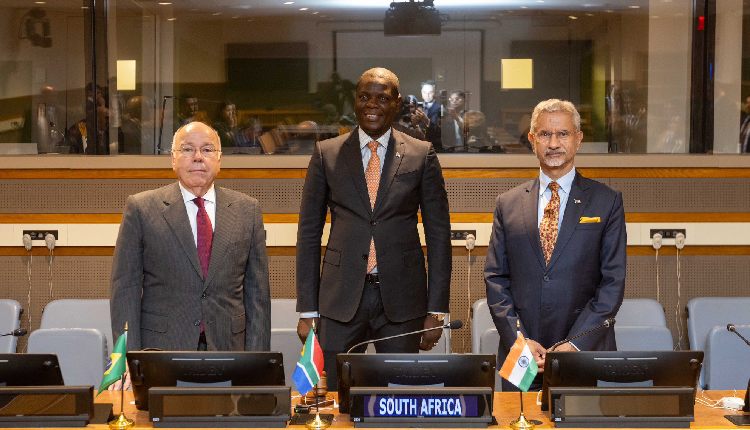






New York: External Affairs Minister S Jaishankar met with Foreign Ministers Ronald Lamola of South Africa and Mauro Vieira of Brazil who jointly condemned the Pahalgam terrorist attack last year and reaffirmed their commitment to zero tolerance for terrorism.The ministers of the three countries that form the IBSA Dialogue Forum met here on Thursday and, in a joint statement, called for a comprehensive UNSC reform to make it more democratic, representative, legitimate and reflective of contemporary realities, according to Jaishankar.Similarly, they said the global economic governance system should have more effective, equitable and representative participation of developing and emerging economies.EAM Jaishankar posted on X: “Participated in the IBSA Foreign Ministers’ Meeting today with FM @RonaldLamola of South Africa and FM Mauro Vieira of Brazil. #UNGA81″“Our Joint Media Statement underscored: Commitment to the UN Charter, international law and a stronger multilateral system. Support for comprehensive UNSC reform to make it more democratic, representative, legitimate and reflective of contemporary realities. Concern over the spillover of conflicts on the Global South, particularly through energy and food insecurity, inflation and fiscal pressures. Strong condemnation of the Pahalgam terror attack and reaffirmation of zero tolerance for terrorism…” he added.The joint statemnt also undersocred full commitment to empowering women and girls and removing social and economic barriers.The democratic countries from the three continents of the Global South are among the major emerging economies with several common interests.They stressed the need to protect balanced, fair and mutually beneficial trade for equitable growth, inclusive development and greater resilience, according to EAM Jaishankar.The ministers emphasised the urgency of fighting climate change, which was leading to increasingly frequent and intense disasters and shocks that threaten sustainable development.They expressed support for tripling renewable energy capacity in the Global South, doubling the global average rate of energy-efficiency improvements, and expanding sustainable fuels including biofuels, biogases and low-emission hydrogen.They paid particular attention to the fast-changing world of technology, making a commitment to universal, meaningful connectivity and greater deployment of digital infrastructure.They also recognised the immense potential of artificial intelligence to drive economic growth and sustainable development.
IBSA Ministerial Meeting Of India, Brazil And South Africa Condemns Pahalgam Terror Attack