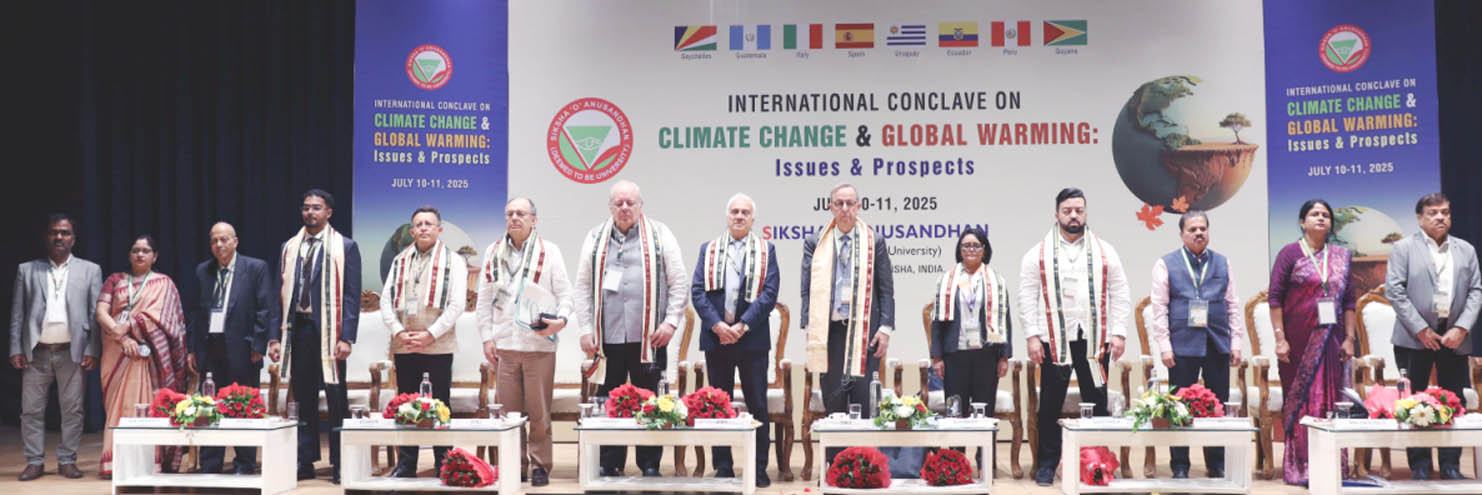






Bhubaneswar, July 10: Ambassadors and diplomats from eight different countries on Thursday expressed
concern over the impact of ongoing climate change and global warming in the world while calling for focused action to
save the planet.
“It is not a distant threat, it stands as a huge challenge before humanity,” Mr. Juan Antonio March Pujol,
Ambassador of Spain, said while addressing the inaugural session of the 2-day international conclave on ‘Climate Change
and Global Warming—Issues and Prospects’ organised by the SOA Deemed to be University here.
The representatives of the other countries who addressed the conclave included Mr. Alberto Guani, Ambassador
of Uruguay, Mr. Javier Paulinich, Ambassador of Peru, Mr. Fernando Bucheli, Ambassador of Ecuador, Mr. Omar
Castaneda Solares, Ambassador of Guatemala, Mr. Antonio Bartoli, Ambassador of Italy, Ms. Lalatiana Accouche, High
Commissioner of Seychelles and Mr. Kayshav Tewari, Diplomat, High Commission of Guyana.
Dr. Mrutyunjay Mohapatra, Director General of Indian Meteorological Department (IMD), delivered the keynote
address while Prof. (Dr.) Neeta Mohanty, Acting Vice-Chancellor of SOA presided. Prof. (Dr.) Prasenjit Mohanty, Pro-Vice
Chancellor of SOA, welcomed the guests.
Prof. Uma Charan Mohanty, Distinguished Professor at SOA and an environmental expert, said that 17 speakers
including scientists, researchers, academics and experts drawn from several top Indian institutions including the IMD,
Indian Institute of Tropical Meteorology (IITM), ISRO and IITs, will be addressing the different sessions of the conference.
Ms. Accouche, High Commissioner of Seychelles, said her country, a small island nation in Africa, was worst
affected as it was faced with rising sea levels, coastal erosion and extreme weather which posed significant threat to the
country’s economy, particularly tourism and fishing industries, and its natural environment.
“Though we are the least contributor to the process of global warming, we are the worst affected by its impact,”
she said.
Mr. Tewari echoed Ms. Accouche saying those who contributed the least to climate change were its biggest
victims.
Guyana, with a population of eight lakh, had been pursuing policies to protect the environment and was now
known as a green super power, he said.
The country had protected its pristine forest covering 85 per cent of the geographical area which served as a
carbon sink, Mr. Tewari said adding countries needed to be compensated for the global good they did.
Dr. Mohapatra said release of greenhouse gases due to human and socio-economic activity had been
responsible for the present situation and the impact had been reflected in extreme weather events.
Forests and wetlands, which served as natural sink for Carbon Dioxide, were shrinking due to deforestation and
human activity. But measures to prevent deforestation and protect water bodies were being taken, he said.
Dr. Mohapatra said climate change was affecting the economy as there had been 6 to 10 per cent reduction in
agricultural yield due to rising temperature. It was also adversely affecting fishing activity, he said adding it impacted
lives and livelihood.
There was a need for installing early warning systems in regions vulnerable to extreme weather conditions while
sustainable development practices should be pursued at the micro level to combat climate change, he said.
Mr.Pujol said anthropogenic activity had impacted the climate causing the sea level to rise by more than 20 cm
since 1900 while countries were facing extreme weather events like cyclones, floods and drought.
Spain, he said, was committed to achieve carbon neutrality by 2050 and supported the initiatives being taken by
the European community to address the situation.
Mr. Pujol said universities were the incubators to provide solutions to problems being faced by humanity and it
was the students who should ensure that the planet remained a safe place.
Italian Ambassador Mr. Bartoli referred to the recent Texas floods saying nobody saw it coming. Italy had broken
the records for extreme weather events, he said adding it was paradoxical that despite the advancement made by
humans technologically it did not guarantee them control over nature.
Mr. Paulinich, who represents Peru, said that 71 per cent of the glaciers in his country, which were the prime
source of water were on the decline. “The glaciers are retreating and facing extinction. It is not ice, but our future that is
melting,” he said.
WORLD WORRIED OVER CLIMATE CHANGE: DIPLOMATS