





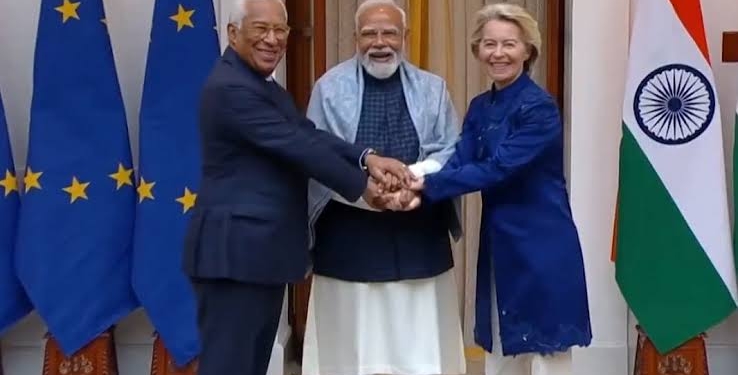
European Commission President Ursula von der Leyen on Tuesday announced the conclusion of the long-awaited India–European Union free trade agreement (FTA), describing it as a historic milestone for bilateral relations. The leaders on both sides have referred to the pact as the “mother of all deals” due to its scale, economic significance, and far-reaching impact.The announcement marks the formal end of negotiations that resumed in June 2022, nearly nine years after talks were initially paused. The FTA integrates a combined market of almost two billion people and represents roughly 25% of global GDP and one-third of global trade.Sharing a photograph with Prime Minister Narendra Modi, von der Leyen wrote on X (formerly Twitter), “Europe and India are making history today. We have concluded the mother of all deals. We have created a free trade zone of two billion people, with both sides set to benefit. This is only the beginning. We will grow our strategic relationship to be even stronger.”PM Modi Highlights Global SignificancePrime Minister Narendra Modi underscored the deal’s global economic importance. Calling it a model partnership, he said:“This is a perfect example of a partnership between two major economies of the world. This agreement represents 25% of global GDP and one-third of global trade.”He further added, “Yesterday a big agreement was signed between the European Union and India. People are calling this the mother of all deals. This agreement will bring major opportunities for the public in India and Europe.”Trade ImplicationsThe India-EU FTA is expected to significantly boost trade between India and the 27 EU member states, including major economies such as Germany, France, Italy, Spain, and Belgium. Currently, the EU is India’s largest trading partner, with bilateral trade in goods valued at $135 billion in 2023–24.The agreement is projected to allow duty-free access to over 90% of Indian goods in the EU market, benefiting sectors such as textiles, leather, gems, jewellery, engineering goods, and IT services. Analysts also note the FTA comes at a critical time amid global supply chain restructuring and trade uncertainties following policy disruptions in other major economies.Strategic and Long-Term ImpactThe FTA is seen as a forward-looking, mutually beneficial partnership, enhancing economic cooperation while strengthening India’s role in a multipolar global order. Beyond trade, the agreement lays the groundwork for defence collaboration, cybersecurity, and strategic engagement between India and the European Union.Commerce Secretary Rajesh Agrawal described the pact as “ambitious, balanced, forward-looking, and mutually beneficial,” highlighting its potential to create jobs, facilitate investment, and drive technology transfer.diplomatic ContextThe agreement was announced during a two-day visit to India by European Council President Antonio Costa and Ursula von der Leyen. Both leaders participated in Republic Day celebrations and held a high-level summit with PM Modi, formally spotlighting the historic FTA. Experts say the deal positions India as a central player in global trade, deepening strategic and economic ties with Europe while enhancing resilience against global supply chain disruptions.