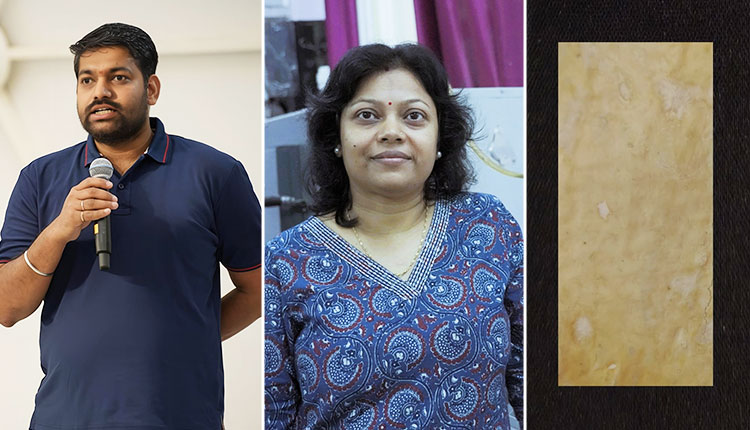






Rourkela: Researchers at the National Institute of Technology (NIT) Rourkela have developed a biodegradable and antimicrobial bio-composite film that could replace conventional plastic-based materials used in healthcare, offering an eco-friendly alternative for products such as wound dressings and bandages.The innovation, developed by researchers from the Department of Biotechnology and Medical Engineering, addresses the twin challenges of biomedical plastic waste and the growing demand for sustainable healthcare materials. Officials said on Tuesday that the technology has also been granted a patent.The research team, led by Dr. Angana Sarkar, Associate Professor, and her research graduate Dr. Pritam Bajirao, secured the patent titled “Biodegradable and Antimicrobial Bio-composite Film and Process for Preparing Thereof” for the innovation.Medical products such as wound dressings and bandages are widely manufactured using petroleum-based plastics, which are non-biodegradable and contribute significantly to environmental pollution after disposal. Although bioplastics such as polyhydroxyalkanoates (PHAs) have emerged as potential alternatives, their commercial application has remained limited because of their brittleness and slow degradation.To overcome these limitations, the NIT Rourkela researchers developed the composite film using a naturally occurring bioplastic produced by bacteria cultivated on sugarcane molasses. They enhanced its strength and flexibility by incorporating naturally extracted neem oil into the material, resulting in a durable, biodegradable film suitable for biomedical applications.“The developed material is completely biodegradable and environmentally sustainable. Laboratory tests showed improved mechanical strength, flexibility, thermal stability and hydrophobicity, making it a promising alternative to conventionally used biomedical films,” Dr. Sarkar said.Apart from being environmentally friendly, the composite film also possesses antimicrobial and wound-healing properties. According to the researchers, the neem oil incorporated into the material inhibits bacterial growth while creating a favourable environment for faster wound healing.The technology has potential applications in antimicrobial films, biomedical coatings, plastic-free bandages, wound dressings and other sustainable healthcare products.Researchers estimated the production cost of the bio-composite film at around Rs. 14.33 for a sheet measuring approximately 44.18 square centimetres, suggesting strong potential for economical large-scale manufacturing.The innovation is in line with the Government of India’s Atmanirbhar Bharat, Make in India and National BioE3 Policy initiatives. Researchers believe the technology could significantly reduce healthcare-related plastic waste while improving patient safety through its natural antimicrobial properties.
NIT Rourkela Develops Biodegradable Bio-Composite Film For Healthcare Sector