




Jajpur : Reinforcing its commitment to responsible mining, community well-being, and ecological stewardship, M/s FACOR Ltd. conducted an Environmental Sustainability Programme on 06 January 2026 through its Ostapal Chromite Mine and Kalarangiatta Chromite Mine in Jajpur district, Odisha.
The initiative was undertaken along the banks of Damasala Nallah, with a focus on strengthening soil stability and reducing the mobilisation of naturally occurring hexavalent chromium (Cr⁶⁺) through science-based phytoremediation and environmental management practices. Scientific studies have established that the Sukinda Valley is a chromite-rich ultramafic geological belt where chromium is naturally present in rock formations and overlying soils due to long-term geological and weathering processes. During seasonal surface water flow, natural soil erosion and sediment transport may lead to increased mobilisation of chromium-bearing soil particles into nearby watercourses. Recognising this regional geological characteristic, FACOR has proactively initiated a pilot phytoremediation programme to enhance natural attenuation mechanisms and improve ecological resilience.
The programme is being implemented in collaboration with the Odisha State Pollution Control Board (OSPCB) and the Department of Environment & Sustainability, CSIR–Institute of Minerals and Materials Technology (CSIR–IMMT), under the leadership of Dr. N. K. Dhal, Chief Scientist and Head of the Department.
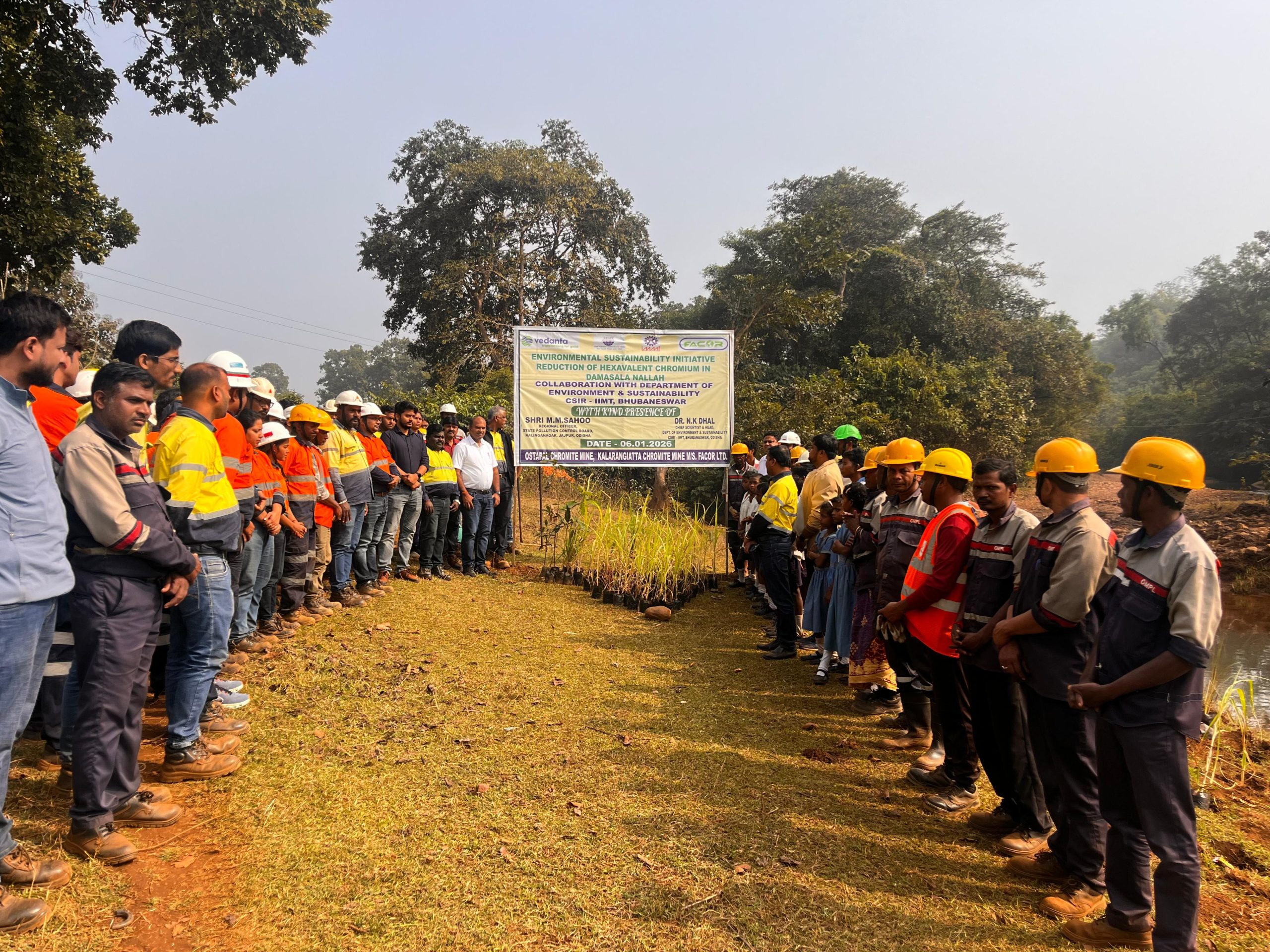
As part of the initiative, a large-scale phytoremediation plantation drive was carried out along the banks of Damasala Nallah, with enthusiastic participation from over 120 individuals, including FACOR employees, school students, and members of the local community. More than 2,000 saplings were planted to minimise soil erosion, enhance ecological balance, and support long-term environmental sustainability.
The programme was graced by Shri M. M. Sahoo, Regional Officer, OSPCB (Jajpur), who attended as the Chief Guest, along with officials from the State Pollution Control Board, Kalinganagar, Jajpur, Odisha. Shri Muthumari M., Head – Mines, M/s FACOR Ltd., was also present during the event.
During the programme, OSPCB officials sensitised students, community members, and employees on the importance of environmental protection, sustainable practices, and collective responsibility in conserving natural resources. Shri M. M. Sahoo highlighted the role of preventive and nature-based solutions such as phytoremediation in addressing region-specific environmental challenges.
The initiative was coordinated by Shri Ajay Kumar Patra, Mine Manager, and Shri Susanta Biswal, Head – Geology & Environment, with active participation from FACOR officials and the local community.
Encouraged by the success of this pilot initiative, FACOR plans to scale up similar science-led environmental interventions across the region, reaffirming its commitment to sustainable mining practices, stakeholder well-being, and long-term ecological protection.
FACOR expresses its sincere gratitude to the Odisha State Pollution Control Board (OSPCB) and CSIR–IMMT for their valuable guidance, collaboration, and continued support in strengthening responsible and sustainable mining practices.