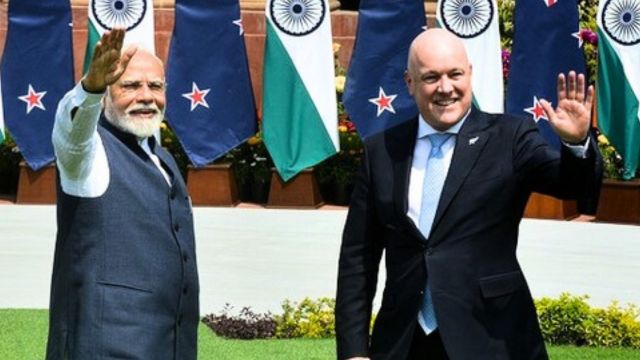






A major trade agreement between India and New Zealand takes effect tomorrow, formalizing an economic compact designed to push commercial ties well past conventional tariff reductions and cross-border import quotas.The pact enters into force following its signing on April 27 and formal ratification on September 21. Both governments have established an ambitious benchmark under their India-New Zealand Strategic Partnership Roadmap: doubling two-way trade in goods and services to NZD 7 billion—approximately Rs 35,000 crore—by 2030.Current trade volumes leave substantial room for expansion. Ministry of Commerce data places total bilateral goods and services commerce at USD 2.4 billion. While Indian services exports grew 13 percent to reach USD 634 million up from USD 561 million, merchandise exports from India expanded 16 percent across the last four years, arriving at USD 566.5 million during the 2025-26 period.Commerce Secretary Rajesh Agrawal, addressing the agreement, stated that the pact is engineered to unite complementary national strengths and cultivate lasting, durable economic engagement rather than solely chasing export volume or preferential market entry. He observed that while corporate investment from New Zealand into India has stayed modest to date, the deal establishes a framework to draw foreign capital into industries where New Zealand firms possess specialized technical depth and operational track records. In his assessment, the payoffs from the treaty must be evaluated across the wider economic landscape.A central operational pillar taking flight under the treaty is an agriculture productivity partnership. The program will deploy New Zealand’s capabilities in precision farming and allied technologies to upgrade multiple facets of India’s agricultural framework.The bilateral opening also reflects India’s broader external trade strategy. Agrawal emphasized that New Delhi is actively pursuing multiple free trade pacts across different geographic territories to construct sturdier, shock-resistant supply chains.That rebalancing addresses a persistent geographical disparity: between 60 and 70 percent of New Zealand’s total commerce remains heavily clustered within the Asia-Pacific territory, where several regional powers maintain far deeper commercial footprints with Wellington than India does. Agrawal pointed out that India’s comparatively modest trade share with the country creates an immediate opening to scale up two-way trade flows over the coming years.
India–New Zealand FTA to Enter into Force Tomorrow to Boost Agri-Tech Ties and Double Trade