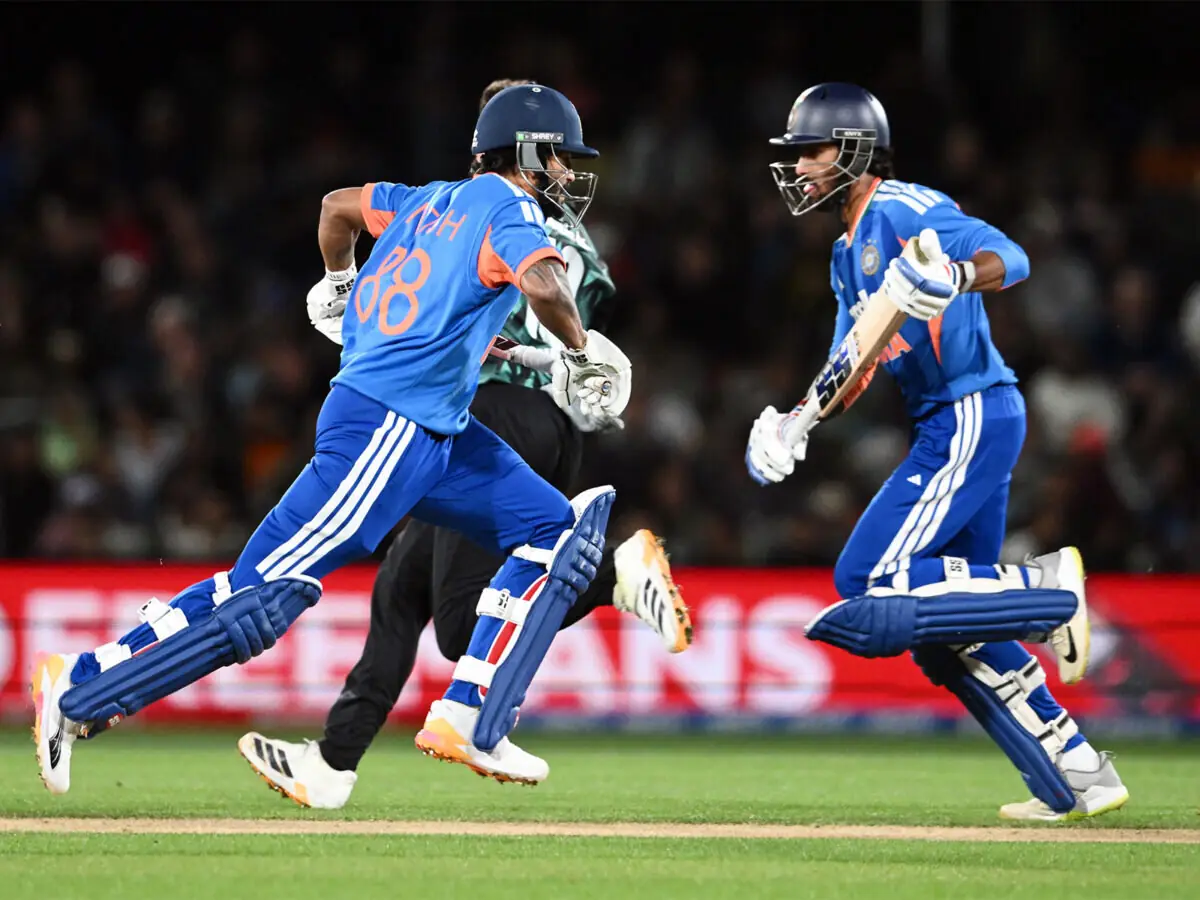






India achieved a record chase in the final five overs of a T20 International against New Zealand, thanks to an unbeaten 69-run partnership between Tilak Varma and Nitish Kumar Reddy. The match took place in Christchurch on October 25 during the second T20I of the series.Requiring 68 runs in the last five overs to reach a target of 181, India reached victory with one ball to spare. The 68 runs scored in the death overs marked India’s highest successful chase in that phase of a T20I innings, surpassing their previous best of 60 runs against Pakistan at the Melbourne Cricket Ground during the 2022 T20 World Cup, where Virat Kohli’s unbeaten 82 had guided India to victory.India completed the chase with five wickets down. Tilak Varma was unbeaten on 51 from 26 balls, striking six fours and one six at a strike rate of 196.15. Nitish Kumar Reddy remained not out on 26 off 13 deliveries, including one four and one six, at a strike rate of 200. The duo’s unbroken seventh-wicket stand of 69 runs from 30 balls was pivotal, securing the win with a ball remaining.Though there have been nine instances in T20I history where teams scored more runs in the last five overs of a successful chase, those teams had at least five wickets in hand, unlike India in Christchurch.The victory gave India a 2-0 lead in the five-match T20I series, with the third match scheduled for October 27 in Wellington.Reflecting on the match in a video posted on social media by the Board of Control for Cricket in India (BCCI), Tilak Varma described the pitch as slower and the ground larger, with New Zealand’s quick bouncers making six-hitting difficult. “I think the wicket was really challenging today. Especially if you see, big ground, slower side, and also if you see when they were bowling bouncers, it is really coming quick. So it’s not easy to hit whenever you want sixes. Honestly, if you see in the first game, it was easy to hit sixes, but this game was pretty challenging. Then the challenge comes to us, you know, how we want to play smartly, how we played today. We want to show our fitness level, our core works into the game. In those twos, singles, running hard, and whenever we want, we were hitting sixes,” he said.Varma added that he resisted playing big shots while Naman Dhir was batting, fulfilling a promise to head coach Gautam Gambhir and batting coach Sitanshu Kotak to remain patient and take the game deep. Prior to his partnership with Nitish Reddy, Varma and Dhir had shared a 42-run stand, with Dhir scoring 31 off 17 balls.“But one thing, when Naman was batting, for me also I wanted to go for those big shots, but I have promised myself to Gautam sir and Kotak sir that I’ll take the game deep from next time onwards. And last game if you see, my mindset was slightly defensive, that I wanted to take those initial singles and I wanted to take that game deep. But today again, when I was in the crease, I wanted to hit that boundary for spinners, but I played there when Naman was hitting. I thought that, okay, I’ll calm myself and I’ll take the game deep and you know, after that, God’s plan,” Varma said.Nitish Kumar Reddy praised Tilak Varma’s strike rotation while Naman Dhir batted aggressively and highlighted their quick running and proactive approach as key to applying pressure on New Zealand and changing the course of the match.“The thing is, I really enjoyed playing with him. Like I know he’s a quick runner and I’m a quick runner too. We really enjoyed playing together. But the thing which I wanted to appreciate about Tilak is, when Naman Dhir was going pretty well, like he’s striking tremendously, and then Tilak came in, and he took… he’s not risking at all. He just gave a single to Naman, and then Naman did his thing. And then when Naman got out, when Tilak and I were playing, we were just proactive, and things changed in a very fraction of a second. You say T20 cricket is just a matter of one over, and we proved it. We just got the twos, fours, and we put pressure on opponents, and that’s what we’ve done best, I think,” he stated…
Tilak Varma and Nitish Kumar’s 69-run stand secures India’s record T20I death-over chase