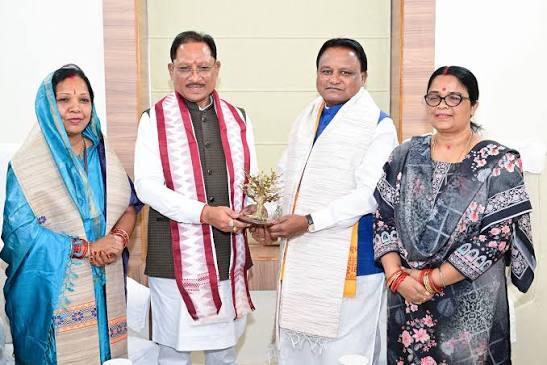





Reliable sources in the Odisha government say Chief Minister Mohan Charan Majhi will travel to Chhattisgarh once the ongoing Assembly session ends, meet counterpart Vishnu Deo Sai, and carry forward talks on a durable settlement of the long-running inter-state water dispute. A firm date has not been announced. Officials say the calendar will be locked only after the House rises. The timing is not accidental. This monsoon, the Mahanadi basin has already seen repeated flood spells — officials in the original briefing counted five — turning reservoir operations at Hirakud into a high-stakes balancing act. Sudden upstream releases swell the lower basin. Lean-season flows, meanwhile, leave less water for irrigation, drinking supply, power and the environment. That combination has pushed the state to reopen the dam’s decades-old “rule curve,” the operating manual that decides how much water Hirakud stores and when it lets go. Only days ago, Sai was in Bhubaneswar. He called on Majhi at the Chief Minister’s official residence, described the Mahanadi issue as no longer a political flashpoint because both states now have BJP governments, and said both sides were ready to accept a Central Water Commission-backed formula in the interest of the basin. Majhi called the interaction “fruitful.” The planned Raipur visit is being read as the return call: courtesy first, then substance. What that substance looks like is already taking shape. Officials expect the bilateral conversation to cover reservoir releases, coordinated flood management and a revised rule curve. The argument from Odisha’s side has been consistent for years: upstream barrages and anicuts — including projects such as Kalma — have changed the river’s behaviour. In the dry months, less water reaches Hirakud. In the rains, gates open and the lower delta pays the price. The legal file is older than either government. In 2016, the then Biju Janata Dal government moved the Centre and the Supreme Court. In 2018 the Mahanadi Water Disputes Tribunal was constituted. Hearings have dragged on. This year the Centre has tried to pull the two states onto a negotiated track. On July 30, Union Jal Shakti Minister C. R. Patil chaired a meeting with both chief ministers in New Delhi. Technical committees under the CWC have since been expanded. Both governments have said they want an amicable, technically grounded settlement rather than another long wait in court. That political alignment is the new variable. With similar governments in Bhubaneswar and Raipur, and the Centre offering CWC facilitation, officials privately argue that a basin-wide compact is more possible now than at any point since the dispute hardened. Experts watching the river put it more bluntly: if the two states cannot agree on how to share a flood and a drought on the same river, the next monsoon will write the same headline again. Majhi’s proposed visit will not, by itself, close a case that has lived in files since 2016. It can, however, turn a courtesy meeting into a working agenda — releases, flood protocol, rule-curve revision — before the tribunal’s clock and the next low-pressure system both run out of patience.
Odisha CM Majhi to Visit Chhattisgarh After Assembly Session for Mahanadi Water Talks