




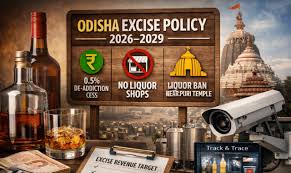
The Odisha Government has announced a landmark triennial Excise Policy for the period April 1, 2026 to March 31, 2029 — or until a new policy is notified — replacing the earlier practice of annual policies.The move is aimed at bringing long-term stability, transparency and predictability to the excise sector while allowing mid-course corrections whenever necessary.A major highlight of the new policy is the imposition of a 0.5 per cent De-Addiction Cess on excise duty. By levying this cess, the government has formally recognised liquor as a harmful substance. The entire revenue generated from the cess will be used exclusively for setting up and strengthening de-addiction centres across the state.In a bid to increase revenue and regulate the trade, application fees for various excise licences have been hiked by 10 per cent, while annual licence fees will rise by 10-20 per cent every year. Excise duty on Indian Made Foreign Liquor (IMFL) and Country Liquor (CL) has also been increased.One of the most significant structural changes is the replacement of the Minimum Guaranteed Quantity (MGQ) system with the Minimum Guaranteed Excise Revenue (MGER) model. Officials said the new system will protect government revenue while reducing pressure on licensees to push excessive sales merely to meet quantity targets. This is expected to help curb the menace of “kuchia” (illicit/spurious) sales.To check proliferation of liquor outlets, the policy imposes a complete ban on new OFF, CL and OS shops across the state. No new ON shops will be permitted in rural areas either, except in three-star and above hotels and clubs located in industrial zones. In a major cultural and religious gesture, no excise outlets will be allowed near the Shree Jagannath Temple and Bada Danda in Puri. Home delivery of alcohol has also been prohibited.Out-Still (OS) manufacturing units have been directed to undertake mandatory modernisation, adopt improved packaging and install quality-control equipment. FSSAI certification and pollution-control norms have been made compulsory. Units that complete modernisation within the stipulated timeline will receive incentives.In a major transparency drive, the government will implement a Track & Trace system to monitor Extra Neutral Alcohol (ENA) from production to retail sale of every bottle. All manufacturing units and retail outlets will be brought under 24×7 CCTV surveillance, with live feeds linked directly to the office of the Excise Commissioner and the respective district offices. The state’s excise chemical laboratories will also be upgraded with modern equipment and trained manpower.The policy is expected to balance revenue generation with public health concerns and stricter regulation of the liquor trade in Odisha.