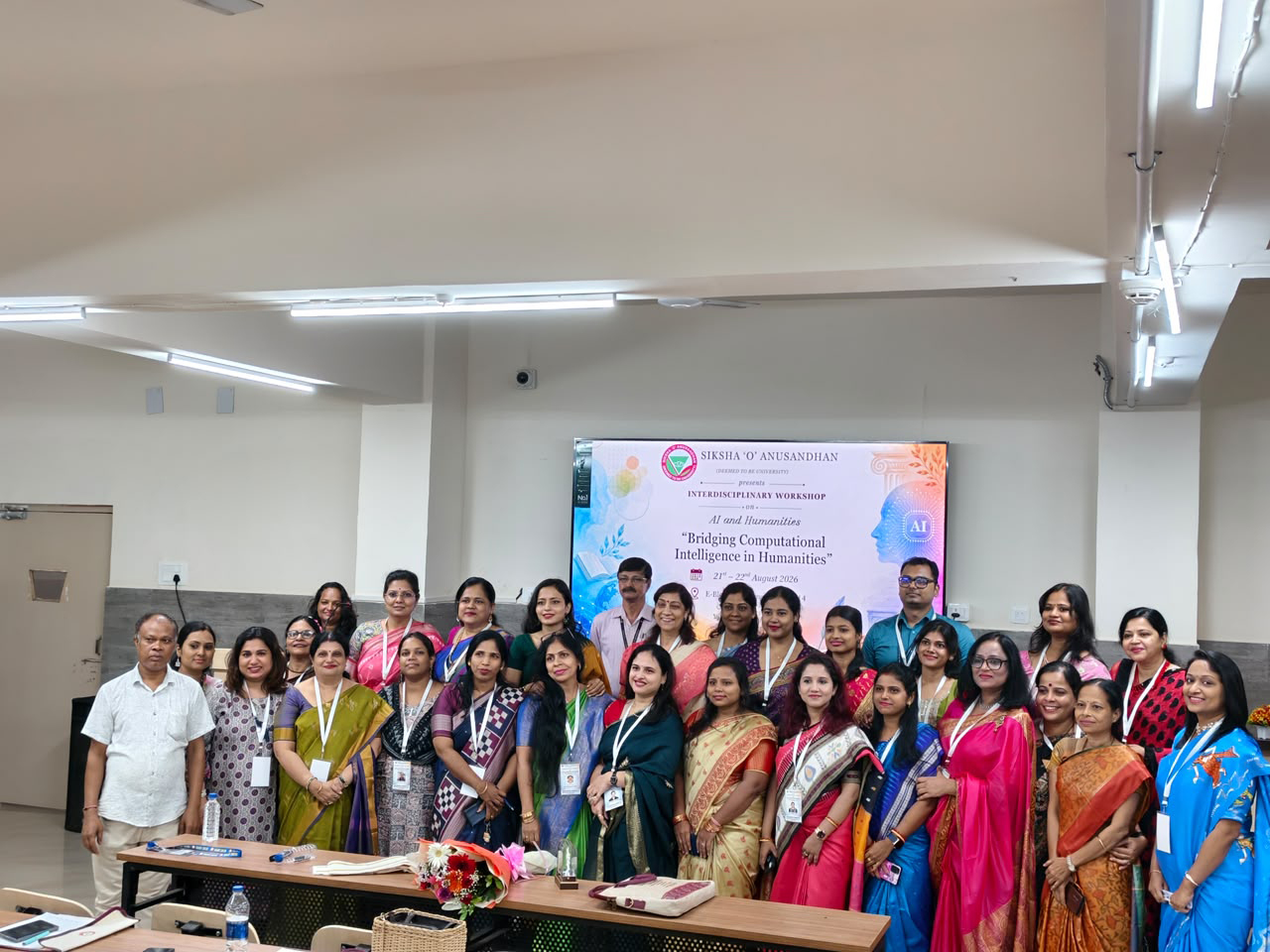

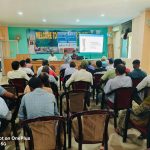



Bhubaneswar, Aug. 26: The emerging interface between Artificial Intelligence (AI), humanities
and social sciences figured prominently at a two-day interdisciplinary workshop held at the Institute of
Technical Education and Research (ITER), faculty of engineering of SOA Deemed to be University here,
on August 21 and 22.
The workshop on ‘AI and Humanities: Bridging Computational Intelligence in Humanities’, which
brought together eminent academicians, researchers, faculty members and students, aimed to promote
collaboration between humanities and data science and introduce emerging AI technologies to faculty
members and students, explore applications of AI in education, research, language, literature, history
and social sciences, while focusing on developing AI literacy and responsible AI practices.
Organised by ITER’s department of Humanities and Social Sciences, the workshop also sought to
foster interdisciplinary research and innovation.
The inaugural program was graced by Prof. K.C. Mishra, Emeritus Professor at Bharatiya Vidya
Bhavan and Mr. Sugyan Choudhury, Senior Journalist with The Pioneer. Mr. Choudhury said that values
and creativity could never be replaced by AI while pointing out that intelligence could never be artificial.
AI is a tool which facilitates and speeds up work, he said.
The program was hosted by Dr. Prachishri Mishra while Dr. Swayam Prabha Satpathy, Chief
Coordinator and Convenor, delivered the welcome address. Dr Stitaprajna proposed the vote of thanks.
The speakers who addressed different sessions included Prof. Rabindra Kumar Pradhan,
Professor, Department of Humanities and Social Sciences at IIT Kharagpur, who explored the relevance
of AI to behavioral sciences and its selected applications in understanding human behavior.
Prof. Shikha Bhardwaj, Professor at IIM Sambalpur, addressed the second session. She discussed
the role of computational approaches and AI in humanities research while covering AI applications in
literature, language, history, culture and communication.
Another session on the subject ‘Ethics and Responsible AI’ was conducted by Prof. Rakesh
Chandra Balabantaray, Professor in the Department of Computer Science at IIIT Bhubaneswar, who
spoke on the critical concerns including bias, fairness, privacy, academic integrity, hallucination,
responsible use of AI and human oversight.
The workshop was distinctive in its genuinely interdisciplinary approach. Rather than examining
AI solely as a technological innovation, the program explored its implications and applications across
behavioral sciences, literature, language, culture, communication, ethics, research, and ethnography.
The four thematic tracks—Foundations of Artificial Intelligence, Digital Humanities, Ethics and
Responsible AI and Digital Ethnography—provided a structured progression from understanding AI
fundamentals to examining its responsible and practical applications in the humanities.
Another key feature was the emphasis on responsible, human-centered use of AI. The
participants were encouraged to understand AI not simply as a set of technological tools, but as an
emerging force with wider social, cultural, ethical and intellectual implications. The workshop aimed to
develop AI literacy, responsible technology practices, stronger digital and research competence, AI-
assisted academic writing and research practices and opportunities for interdisciplinary collaboration.
The workshop also sought to bridge the gap between theoretical understanding and practical
engagement. The program combined theory, hands-on training, demonstrations and collaborative
activities, enabling participants to explore both the possibilities and challenges of AI in humanities
research and education.
The final academic session conducted by Prof. Manas Ranjan Patra, Professor, Department of
Computer Science at Berhampur University, delved into the subject ‘Computational AI and Digital
Ethnography: From Digital Footprint to Humanities’ and examined computational AI applications in
humanities research, AI-assisted academic communication and computational approaches to
ethnographic research.
Dr. Manjula Das, Controller of Examinations, SOA Deemed to be University, was the Chief Guest
at the valedictory session while Prof. Patra was the Guest of Honor. Dr Mousumi Dash delivered the
welcome address and Dr Swayam Prabha Satpathy proposed the vote of thanks.
An Advisory Board comprising Dr. Manas Kumar Mallick, Dr. P. K. Sahoo, Dr. D. N. Thatoi, Dr.
Jayanta Nath, Dr. Renu Sharma, Dr. Sasanka Choudhury, Dr. Satish Choudhury and Dr. Tapas Mohapatra
supported the academic program.
SOA ORGANISES WORKSHOP TO BRIDGE COMPUTATIONAL INTELLIGENCE IN AI AND HUMANITIES