




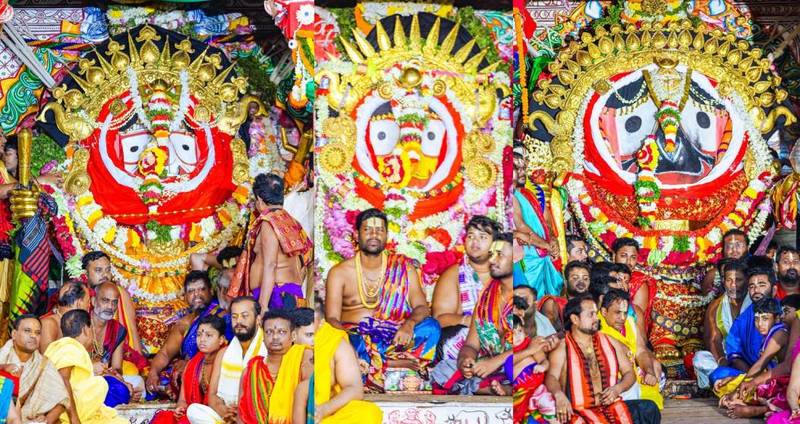
The much-awaited Suna Besha, also revered as Rajarajeswara Besha, will be observed this evening at the Jagannath Temple in Puri. On this auspicious Asadha Sukla Ekadasi Tithi, the deities — Lord Jagannath, Lord Balabhadra, and Devi Subhadra — will be adorned with exquisite golden ornaments, offering a divine spectacle to lakhs of devotees.
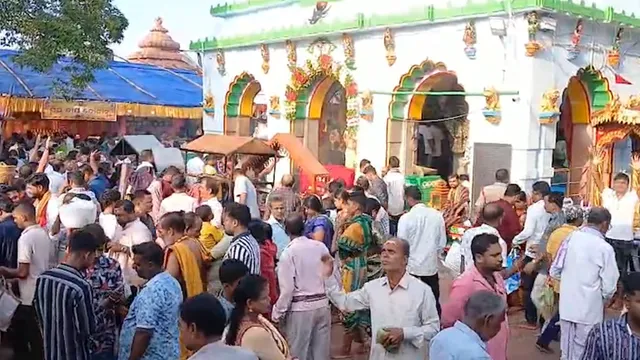
The atmosphere is already charged with devotion and excitement as thousands of devotees are heading to Puri to witness the grand Suna Besha. The golden adornment of the deities is one of the most magnificent and revered events in the Jagannath tradition, drawing devotees from across the country.
With the temple administration leaving no stone unturned for smooth conduct of the grand event, Ommcom News delves into the fascinating history and lesser-known facts surrounding this resplendent celebration.
History
According to the Madala Panji, the ancient chronicle of the Jagannath Temple, the tradition originated during the reign of Gajapati King Kapilendra Deba. After achieving a glorious victory against the Deccan rulers in 1460 with the blessings of Lord Jagannath and Maa Jayadurga, the king returned with vast treasures, including gold loaded on 16 elephants. In an extraordinary gesture of devotion, he offered the entire wealth to Lord Jagannath and expressed his desire to create beautiful golden ornaments for the deities. The task was entrusted to Tadhau Karana, the custodian of the royal gold, who brought the king’s vision to fruition.However, Tadhau Karana humbly approached Gajapati Kapilendra Deba with a heartfelt request. He pointed out that a large number of devotees were unable to enter the temple and have darshan of the deities in their divine ornaments. To address this, he suggested that the Suna Besha be brought out and displayed on the chariots during Bada Ekadashi. This would allow devotees from all walks of life to witness the magnificent golden splendour of Lord Jagannath, Lord Balabhadra, and Devi Subhadra. The king graciously accepted the proposal, and thus, the grand tradition of the annual public Suna Besha celebration was born.During this grand occasion, the deities are adorned with approximately 208 kilograms of gold, a sight to behold. History says, during Kapilendra Deba’s reign, the deities were adorned with an astonishing 138 designs of gold ornaments. Although the number of designs has decreased over time, the deities are still majestically decorated with 20 to 30 types of gold ornaments, a testament to the enduring legacy of Kapilendra Deba’s devotion.Odisha News, Odisha Breaking News, Odisha Latest News || Ommcom News
Home Odisha
Suna Besha: When A King Offered 16 Elephants Loaded With Gold To Jagannath
OMMCOM NEWS by OMMCOM NEWS July 25, 2026
The much-awaited Suna Besha, also revered as Rajarajeswara Besha, will be observed this evening at the Jagannath Temple in Puri. On this auspicious Asadha Sukla Ekadasi Tithi, the deities — Lord Jagannath, Lord Balabhadra, and Devi Subhadra — will be adorned with exquisite golden ornaments, offering a divine spectacle to lakhs of devotees.
The atmosphere is already charged with devotion and excitement as thousands of devotees are heading to Puri to witness the grand Suna Besha. The golden adornment of the deities is one of the most magnificent and revered events in the Jagannath tradition, drawing devotees from across the country.
With the temple administration leaving no stone unturned for smooth conduct of the grand event, Ommcom News delves into the fascinating history and lesser-known facts surrounding this resplendent celebration.
History
According to the Madala Panji, the ancient chronicle of the Jagannath Temple, the tradition originated during the reign of Gajapati King Kapilendra Deba. After achieving a glorious victory against the Deccan rulers in 1460 with the blessings of Lord Jagannath and Maa Jayadurga, the king returned with vast treasures, including gold loaded on 16 elephants. In an extraordinary gesture of devotion, he offered the entire wealth to Lord Jagannath and expressed his desire to create beautiful golden ornaments for the deities. The task was entrusted to Tadhau Karana, the custodian of the royal gold, who brought the king’s vision to fruition.
However, Tadhau Karana humbly approached Gajapati Kapilendra Deba with a heartfelt request. He pointed out that a large number of devotees were unable to enter the temple and have darshan of the deities in their divine ornaments. To address this, he suggested that the Suna Besha be brought out and displayed on the chariots during Bada Ekadashi. This would allow devotees from all walks of life to witness the magnificent golden splendour of Lord Jagannath, Lord Balabhadra, and Devi Subhadra. The king graciously accepted the proposal, and thus, the grand tradition of the annual public Suna Besha celebration was born.
During this grand occasion, the deities are adorned with approximately 208 kilograms of gold, a sight to behold. History says, during Kapilendra Deba’s reign, the deities were adorned with an astonishing 138 designs of gold ornaments. Although the number of designs has decreased over time, the deities are still majestically decorated with 20 to 30 types of gold ornaments, a testament to the enduring legacy of Kapilendra Deba’s devotion.
Ornaments Used in Suna Besha
The priceless gold ornaments are carefully preserved in the outer chamber of the Ratna Bhandar. Escorted by armed policemen and senior temple officials, the Bhandara Mekap priests bring out the jewellery and formally hand them over to the Puspalaka and Daitapati priests, who then adorn the deities. The following is the list of ornaments used during the Suna Besha.
Suna Hasta – Golden Hand
Suna Payar – Golden Feet
Suna Mukuta – Golden Crown
Suna Hasta – Golden Hand
Suna Payar – Golden Feet
Suna Mukuta – Golden Crown
Suna Mayur Chandrika – A Golden Peacock Feather Used By Shri Jagannath
Suna Chulapati – A Golden Ornament Worn Traditionally On The Forehead
Suna Kundal – Golden Earring Of Hanging Round Ball Type
Suna Rahurekha – A Half-Square-Shaped Golden Aura Around The Deities
Suna Mala – Necklaces With Several Designs Made Of Gold. These include:
Padma Mala –Necklace Of Lotus Flower
Sevati Mala – Necklace Of Chrysanthemum Flower
Agasti Mala – Necklace Of Moon Shaped Flower Design
Kadamba Mala – Necklace Of Kadamba Flower
Kante Mala –Necklace Big Gold Beads
Mayur Mala – Necklace Shaped As Peacock Feathers
Champa Mala –Necklace Of Champak Flower
Suna Chakra – Golden Wheel
Suna Gada – Golden Bludgeon
Suna Padma – Golden Lotus
Rupa Sankha – A Silver Conch