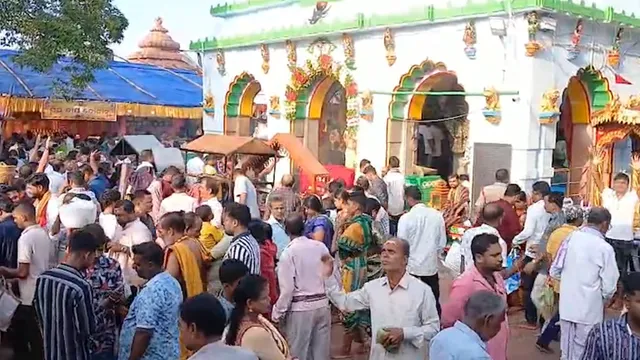




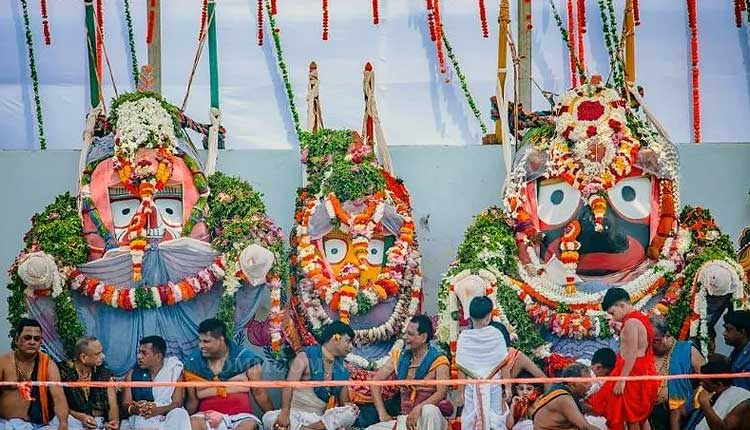
Under the luminous glow of the full moon, the ancient temple city of Puri pulses with an almost electric devotion. Thousands stand shoulder to shoulder, hearts racing, as the majestic wooden forms of Lord Jagannath, Balabhadra, Subhadra, and Sudarshan are carried out into the open air. Today is Debasnana Purnima — the day the Supreme Lord, who rules the universe, allows His devotees to see his bathing ceremony.The Ancient Roots of A Timeless TraditionOn this day, the Supreme Lord, who is worshipped as the Lord of the Universe, steps out not merely to be seen, but to be bathed — openly, directly, and with tender devotion — in a ritual that has no parallel anywhere else in the world. While the deities receive daily baths through the symbolic “Bimba Snana” (bathing of the reflection in a mirror), Snana Purnima marks the rare occasion of ‘Pratyaksha Snana’ — the direct, visible bathing of the Daru Brahma (wooden forms) of Jagannath, Balabhadra, Subhadra, and Sudarsan. This is no ordinary bath.According to sacred texts, when Lord Jagannath first manifested in his wooden form, King Indradyumna performed this very snana in an auspicious moment. In the absence of the present-day Snana Mandap, a wooden platform (mancha) was built, giving the ritual its ancient name — Mancha Snana. Scriptures prescribe the use of 108 consecrated pots of water, a tradition meticulously followed even today.A Night of Sacred Movement
As per tradition, the sacred rituals of Snana Purnima begin the night before the holy bath. In the dimly lit sanctum, the Daita servitors — the hereditary custodians of the deities — gently prepare the four divine forms for the momentous journey ahead. With utmost care and devotion, they adorn the deities with the Chenapatta, a protective body armour, to shield the sacred wooden forms from any strain during the elaborate Pahandi procession. Meanwhile, another group of servitors carefully secures the massive Charmalas — enormous, sturdy ladders — to the majestic Ratna Singhasan (the Jewel Throne). These ladders serve as sacred pathways, enabling the smooth and dignified descent of the deities from their throne to the Snana Bedi below.The day before Purnima, the deities are prepared within the sanctum. The air fills with the sound of conch shells and rhythmic chants as the Daitapatis (hereditary servitors) carry the four deities in a grand procession known as Dhadi Pahandi. Lord Sudarshan leads, followed by the majestic Balabhadra, graceful Subhadra, and finally the all-attractive Jagannath himself, moving with gentle, swaying steps.The Grand Procession and the Holy WatersThe water for this sacred bath is drawn from the hidden Suna Kuan (Golden Well), guarded year-round near Shitala Thakurani. This water, rarely used otherwise, is considered especially pure. Before the bath, it is sanctified with a unique blend of thirteen medicinal herbs and substances. One by one, the deities are placed on the Snana Mandap. In a deeply moving sequence, 108 fragrant pots of water are poured over them: 35 for Jagannath, 33 for Balabhadra, 22 for Subhadra, and 18 for Sudarshan. Following the bath, the Gajapati Maharaja performs the Chhera Pahara — the ceremonial sweeping of the platform — symbolizing the humility of even the greatest king before the Lord.The Heartwarming Legend of Gajanan Besha
Following the grand bathing ritual, the sibling deities are adorned in the Hati Besha, a unique form in which they resemble Lord Ganesha. This special appearance is worshipped with the belief that it removes obstacles and brings blessings to devotees.Long ago, a devout Brahmin named Ganapati Bhatta journeyed from Maharashtra to the holy land of Sri Kshetra, his heart overflowing with love for Lord Ganesha. Having heard of the grandeur of Snana Yatra, he arrived in Puri with great excitement, eager to witness the sacred bathing of the Lord. But the moment his eyes fell upon the majestic wooden form of Lord Jagannath, a wave of deep disappointment washed over him. There was no elephant face — the beloved form he had worshipped his entire life. His heart sank. “This cannot be the Supreme Lord,” he thought. Overcome with sorrow, he turned away from the temple, unable to offer his devotion.After the grand bath and besha, the deities return to the temple in Goti Pahandi and enter the Anasar Pindi. For the next fifteen days, they are believed to rest due to “fever” caused by the extensive bathing. During this time, devotees, unable to have darshan of their beloved Lord, worship Alarnath at Brahmagiri. This separation only deepens their longing, making the Lord’s return during Rath Yatra even more joyous and celebratory